Showing posts with label economy crisis. Show all posts

Thursday, May 2, 2013

My Appeal , this 13th Malaysian General Elections / Rayuan Saya untuk Pilihanraya Umum Ke-13 Malaysia (Part 3 / 5)


[English version after Malay version]


Warga Malaysia yang dikasihi, 5 Mei 2013, hari di mana semua pengundi Malaysia akan menentukan pimpinan negara yang seterusnya. Terdapatnya 5 perkara yang kita semua patut teliti dengan sepenuh minda dan hati yang murni apabila kita mengundi pada 5 Mei (505).

Bahagian 3: Pengurusan Ekonomi yang baik dan menangani rasuah

Dalam kepimpinan Najib Razak, CPI (Index Tanggapan Rasuah) sedunia telah menjadi daripada teruk ke parah. Pada tahun 2003, Malaysia berada di Tangga ke 37 (Tangga pertama- paling kurang rasuah, and tangga tertinggi- paling rasuah) apabila Tun Dr. Mahathir meletak jawatan sebagai Perdana Menteri. Diikuti pada tahun 2008, semasa Tun Abdullah Badawi menjadi Perdana Menteri, Malaysia merosot ke tangga ke 47 dan pada 2011 setelah di bawah kepimpanan Najib Razak , Malaysia merosot ke tangga 60 yang lebih parah. Sekali gus, menunjukkan kepimpinan beliau gagal memerangi gejala rasuah.

Tambah pula, laporan Global Financial Integrity 2012 menunjukkan Malaysia adalah Negara ke-3 tertinggi dalam aliran keluar wang haram diantara 2001 to 2010 pada jumlah dianggarkan pada USD$ 285 Billion!

Malaysia juga telah melihat 15 tahun bajet deficit yang berturut-turut. Tambah pula, hutang Negara yang mencecah RM 500 Billion pada tahun 2012. Halatuju ekonomi negara seterusnya ditentukan oleh undi anda pada 5 Mei nanti.


-------


My fellow Malaysian brothers and sisters,  5th May 2013, a day when all Malaysian voters determine the next leadership of our nation. There are 5 issues that we can all ponder on with our mind, heart and conscience when casting our votes this 5th May (505).

Part 3: Accountable Economic Management and Anti-Corruption

Malaysia's global Corruption Perception Index (CPI) has gotten from bad to worst under the premiership of Najib Razak since 2009. When Dr. Mahathir stepped down as Prime Minister in 2003, Malaysia’s ranking drop from 23rd in 1995 to 37th place. Followed by Tun Abdullah’s premiership till 2008, Malaysia’s ranking plunged further to 47th place. In 2011, under Prime Minister Najib Razak, the ranking fell to all time low of 60th concluding that his leadership has failed to combat corruption miserably.

In addition to that, Global Financial Integrity 2012 reports that Malaysia is the 3rd Highest Nation for cumulative illicit financial outflow from the year of 2001 to 2010 at a colossal amount of USD$ 285 Billion!

Malaysia observed a continuous 15 years of budget deficit and all time high national debt at about RM 500 Billion by 2012. The future of the nation's economy will be determined by your vote this 5th of May!


Vote against corruption

Vote against corrupt, tainted and arrogant leaders

Vote for accountability, competency and transparency

Vote to “Ubah”


Joshua


Tuesday, April 30, 2013

Who do you vote for in the 13GE in Malaysia?

The 13th General Elections of Malaysia is about 7 days away. What are the main issues concerning the voters? Is it local issues like the road conditions, drainage system, community events...etc OR national issues like corruption, leakages, national development policies, economic management...etc? There are three groups of voters:

  1. To some voters that I spoke to, they believe that the current incumbent Barisan Nasional (BN) government has brought development like businesses and schools in their area and those reasons are enough to provide BN another mandate of 5 years on top of 55 years being in power despite the grand abuse of public fund like the National Feedlot Corporation (NFC) Cow-Condominium scandal, Port Klang Free Zone (PKFZ) scandal...etc. These group of voters believe that physical development, job opportunities and direct cash handout to the low-income earners surpasses the gross corrupt scandals involved. In other words, as long as the government give them something, it doesn't matter how much public fund was used to buy those things, then they will keep voting for that kind of government.
  2. To other voters that I spoke to, they believe that any government mandated by the people should bring development that is sustainable (to nature and future generations), accountable (involving public feedback and extensive impact assessment on the socio-economic perspective), transparent (open tender, public accessible information relating to usage of public fund)...etc.These group of voters are usually exposed to alternative information like the online news portal or social network apart to what is provided by the main-stream media.
  3. And interestingly, there is still a substantial amount of voters believe that as long as an elected representative whether as Member of Parliament or State Assemblymen can ensure proper drainage, proper rubbish collection and disposal, ability to direct local councils, smooth road pavement on major roads and school will be re-elected regardless of national issues involving the ruling coalition that the he/she represents. In other words, they don't mind what their elected representatives do or speak at the Parliament and State Assembly as long as they can direct the local councils to fix their road and unclog their drain.
So which voter group do you belong to?

You want a Member of Parliament that can bring local development regardless of possible abuse of public fund and cronyism?

OR a Member of Parliament that can bring sustainable, accountable and meaningful development and speak up for you in National Policies and Economic Management at National level?

OR a Member of Parliament that ensure proper drainage, road pavement and rubbish disposal in your area regardless of what other thing she/he does for you in the Parliament at National level?


Ubah Sekarang! Bersihkan Malaysia!

Joshua


Friday, April 5, 2013

Barisan Nasional's Janji Ditepati 2.0.5

Kerajan Barisan Nasional juga menepati "janji"- Hampir 250,000 rakyat Malaysia diumumkan muflis diantara tahun 2005 sehingga 2012.

Setiap hari mempunyai purata 52 orang yang diumumkan muflis sekarang berbanding purata 36 orang pada tahun 2007.

25% daripada 105,519 rakyat diumumkan muflis dalam masa 6 tahun kebelakangan ini adalah disebabkan tidak membayar hutang kereta.

Tidak melupaka cukai kereta yang tinggi di bawah sistem Kerajaan Barisan Nasional, rakyat kena pinjam untuk membayar cukai kereta!

Wednesday, April 3, 2013

Barisan Nasional's Janji Ditepat 2.0.3


Hutang isi rumah Malaysia adalah antara yang paling tinggi di dunia. Secara puratanya, data menunjukkan isi rumah Malaysia membelanjakan separuh daripada pendapatan isi rumah untuk membayar hutang. Hutang isi rumah adalah persamaan 77% GDP / Produk Domestik Kasar pada 2011. Antara sebab hutang isi rumah yang tinggi adalah cukai kereta yang tinggi, di samping peningkatan pendapatan yang hampir sama dengan peningkatan kos sara hidup.


Saturday, March 30, 2013

Pakatan Rakyat: How car prices in Malaysia can be lowered.

Pakatan Rakyat
 

Inspirasi Negara, Harapan Rakyat
 
 
Harapan Rakyat: Harga Kereta Turun (People's Hope: Lowered car prices)


Tuesday, March 26, 2013

Barisan Nasional's Janji Ditepati 2.0.1

Malaysia' per capita income is only US$ 9,656 compared to Singapore's US$ 46,241! What went wrong? Malaysia is virtually free from catastrophic natural disasters and Malaysia is teemed with natural resources like oil, gas, timber,  precious caves, ancient forests, majestic mountains and paradise islands and vast sources of land and water but yet Malaysians are poorer than Singapore.
 
Answer (1)
- Singapore is an "adopted nation" of the United States
- Comment: United States has been Malaysia's Top 5 trading partner for many years, shouldn't we not too far behind from Singapore then?
 
Answer (2)
- Singapore is smaller, easier to manage and less money spend for public facilities like road...etc.
- Comment: How come Malaysia is not richer than the United States or Australia? Since our land is much smaller compared to United States or Australia?
Answer (3)
- Singapore has less mouth to feed (Less population)
- Comment: Malaysia should then be richer than the United States (Pop: about 300 million) or even richer than South Korea (Pop: about 50 million)!
 
TRUE ANSWER lies within the economy and resource management, policy and projects inplementation by the Barisan Nasional government for the past 55 years?
 
Has Barisan Nasional manage our country well?
 
Is this another unknown Promise Fulfilled? Ask yourself.


Pendapatan per capita Malaysia adalah US$ 9,656 berbanding Singapura yang mempunyai US$ 46,241! Malaysia adalah bebas daripada bencana alam yang teruk, Malaysia mempunyai sumber alam yang banyak seperti minyak, gas, balak, gua, hutan, gunung-ganang yang hebat, kepulauan yang cantik serta tiada kekurangan sumber air dan tanah. Kenapa rakyat Malaysia adalah lebih miskin berbanding Singapura?
 
Jawapan (1)
- Singapura adalah "anak angkat" Amerika Syarikat
- Komen: AS merupakan Top 5 Partner Dagangan Malaysia untuk banyak tahun (Tangga ke 4 selepas China, Singapura dan Jepun mengikut statistik 20110, bukankah kita patut tidak jauh ketinggalan di belakang Singapura?
 
Jawapan (2)
- Singapura adalah lebih kecil, senang diurus dan kos pengurusan negara pun kurang.
- Komen: Kalau begitu, bukankah Malaysia sepatutnya lebih kaya daripada Amerika Syarikat atau Australia? dimana negara kita jauh lebih kecil daripada mereka?
 
Jawapan (3)
- Singapura mempunyai penduduk yang kurang, sebab tu kos menampung penduduk/ rakyat rendah.
- Komen: Kalau begitu, bukankah Malaysia sepatutnya lebih kaya daripada Amerika Syarikat (Penduduk: 300 juta) ataupun Korea Selatan (Penduduk: 50 juta)?
 
JAWAPAN SEBENAR berada dalam pengurusan ekonomi dan khazanah negara, pelaksanaan polisi dan projek kerajaan oleh Barisan Nasional selama 55 tahun ini.
 
 Adakah Barisan Nasional mengurus ekonomi negara dengan baik?
 
Inikah salah satu Janji Ditepati yang tidak diceritakan? Tanyalah sendiri.


Salam Berubah dan Selamatkan Malaysia.
 
Joshua


Saturday, March 23, 2013

Launching Barisan Nasional's Janji Ditepati 2.0

BN Chairman PM Najib Razak has ended his Jelajah Janji Ditepati / Promises Fulfilled tour in Pekan, Pahang last evening on 23th March 2013.
 
Now, it is time to launch the BN's Promises Fulfilled 2.0 series (Janji Ditepati 2.0) to present what also BN has promised and delivered.


true version of
Rakyat Didahulukan, Pencapaian Diutamakan
 
Before GE 13: BR1M diberikan, KR1M ditubuhkan
After GE 13: AES dinantikan, GST dilaksanakan
 
trust me, this Promise will be fulfilled if BN wins GE-13
(percayalah, Janji ini akan ditepati jika BN menang PRU-13)
 
These are also what they have fulfilled in the past years:
 

Tuesday, February 26, 2013

Malaysian Government's debt to approach RM 1 trillion by 2020

Malaysian government’s debt to approach RM1 trillion by 2020

 
by Pak Sako | Monday, 25 February 2013 14:53

CPI


CPI Introduction

This is the second part of a three-part CPI series on Malaysian debt. The first part, entitled, ‘Investigate Malaysia’s debts now’ , surveyed the overall debt situation.
This part examines the trend in government debt. The upcoming part will concern Malaysia’s total debt.
Statistics reveal that in the last 15 years, the Malaysian government’s debt increased at an unprecedented rate.

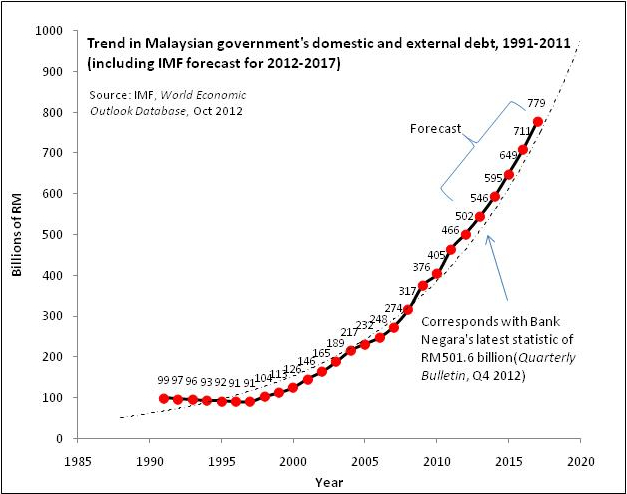
The graph below shows the statistics for the government’s combined domestic and foreign debts from 1991 till the present. Forecasts are provided up to the year 2017.


The figure shows the government’s borrowings from the savings of domestic citizens and from foreign creditors.

Here we ignore private debt, even though it adds to the government’s debt burden, because a portion of private debt is publicly guaranteed. We also ignore other unrevealed debts.

What the statistics are saying
During the 1990s, the reported debt level was mostly flat. It declined slightly towards the end of the decade. At the close of 1991 it was RM99 billion, and by the end of 1996 it was close to 91 billion.
After 1997, the government’s debt began to steadily climb until 2007. In those 10 years, the debt level rose from RM91billion to RM274 billion. This is an increase of RM183 billion, or an annual average addition of debt of RM18.3 billion.

From 2008 onwards, the borrowings escalated exponentially.

In 2008 alone, an extra RM43 billion of debt was amassed. From RM274 billion at the start of that year, the debt level rose to about RM502 billion by the end of 2012 — an increase of RM228 billion in five years. The average increase in debt in this period was RM45.6 billion per year.

The IMF forecast the debt level for the years 2013 to 2017. The annual increase in debt is predicted to be higher, at a yearly RM55.4 billion. The projected debt level for 2017 is RM779 billion.

This assumes that there is still plenty of domestic funds available to carry the borrowing up to that level (the lion’s share of government debt is, after all, domestic debt).

If not, debt would have to be secured from external sources.

The assumption is also that the government will continue to borrow. This is likely to be true. As we have seen, the trend suggests that the government’s appetite for debt has been growing, not abating.
The annual increases in debt are substantial sums: a single year’s borrowing can dwarf a decade’s worth of inward foreign direct investment.

There has been no sign of the debt accumulation reducing or levelling out since the East Asian economic crisis of 1997.

Large government deficits were first incurred in the aftermath of this crisis. Then-prime minister Mahathir Mohamad justified this as part of government spending in commercial enterprises to stimulate the economy.

In reality, the loan proceeds were allegedly used for questionable purposes, such as to fund large-scale projects awarded to crony capitalists and to bail out their failing companies.

The federal government’s borrowing shifted into higher gear from 2008, the year the Barisan National coalition lost its two-thirds parliamentary majority.

The deficit expenditures have been justified as a short-term tool. But they have continued for almost a decade and a half; they have become a permanent feature of the government’s financial policy.

The government’s financial imprudence is therefore a primary cause of the country’s indebtedness.

What this means for the average citizen
It is pertinent to ask whether at this rate Malaysia will attain in 2020 the so-called high-income status envisioned by the New Economic Model.

In the graph, we can see that the government’s debt could come close to RM1 trillion by that year.
The actual debt level might, of course, fall well short of that.

Even so, the strain of the debt load on the people is likely to be significant.

Consider the amount of interest payable every year for the current debt of RM502 billion, or for RM779 billion in 2017. Information on this needs to be disclosed and put into the public realm.

Undertaking debt on this scale is unsustainable for a country of our size and economic potential. The World Bank has said that the Malaysian economy is likely caught in a ‘middle-income trap’.

Economic growth in the years ahead is projected to be slower. Other contributing factors include Malaysia’s wide income and wealth disparities.

When we are compelled to push our land and labour resources to new limits to produce economic growth in the attempt to surmount large debts, there will be damaging social and environmental consequences. We will have to rapidly liquidate our oil and other resources at the expense of the wellbeing of future generations.

The average citizen could be taxed more.

To free up cash to service debt, there could be cost-cutting in the provision of public services, such as healthcare. This might already be happening; recently there were shortages of medicines and blood tests in the public hospitals and health clinics. Workers might also face longer working hours for the same or lower income.

A more devious method may also have to be deployed to deal with domestic debt.

This is when the borrowing government increases money supply by printing money to devalue the debt. The lending citizens lose out. Inflation speeds up and the currency will weaken.

In summary, a ‘new normal’ of a lower standard of living is probable, given:

(i) the increasing scale of government debt and the repayments required for these, and
(ii) the country’s comparatively limited earning potential, bearing in mind the ‘false’ economic growth being attained by irresponsibly depleting natural resources, polluting the land and squeezing greater ‘productivity’ out of the workforce.

Tackling debt ought to be a major subject of political discourse in Malaysia.

Tuesday, February 19, 2013

Dr. M: Don't bite the hands that feed you

Recently, former Malaysian prime minister Tun Dr. Mahathir Mohamed told Federal Land Development Authority (FELDA) settlers "Don't bite the hands that feed you". FELDA is a Malaysian government agency initially founded to resettle rural poor into newly developed areas and to develop small holder farms and in the past decades engages in diversified business activities.
 
The former Malaysian premier has not only endorsed current Prime Minister Najib Razak's campaign to win the coming 13th General Election, where the Parliament will automatically dissolves on 28th April 2013 but also has seen campaign actively for the ruling coalition on the front line.
 
Dr. Mahathir said "Don't bite the hands that feed you"
 
I said to the government "Don't steal from the hands that vote you"
 
We vote politicians into government office is to govern and make policies on behalf on all Malaysians for what is best for the nation and its future. We do not vote politicians into the government office to legitimize the act of possessing the nations' treasure and wealth at its whims and fancies. If the government of the day provides for its citizens, it is its' responsibility and duty as a government elected by the people. So if the government "steal from the hands that voted them in", then its our duty to safeguard the nation's future and wealth by changing the government, voting out a goverment that mismanaged the economy and worsening corruption and leakages.
 
This is it! Let's change!
 
Joshua

Monday, January 7, 2013

Stop lies against Selangor state government: Malaysia's Richest State

Malaysia federal opposition- Pakatan Rakyat (PR) was elected to administer the state governments of Selangor (Malaysia's Richest State) along with Kelatan, Kedah, Penang and Perak in Malaysia's 12th General Elections in March 2008.

However, the elections results was a major setback for the ruling coalition Barisan Nasional (BN)who failed to secure a 2/3 parliamentary majority and lost the state administration of Selangor the first time since independence in 1957. The Selangor State has since been governed by PR but it has ALWAYS appeared on the MAIN-STREAM MEDIA of Malaysia (controlled by the ruling coalition of BN) that PR has failed miserably to govern the state and no-good has come from the PR State Government.

As a "known" pro-opposition blogger by now, despite some branding me as "opposition fanatic", I must remind critics that I stand in support of the PR State Government, which in the case I do not support the State's opposition bench of BN, which means I am not literally an "opposition fanatic".

Today, I stand in support of  the Chief Minister TS. Abdul Khalid Ibrahim of my home state of Selangor, for administering the state with outstanding performance on economic, financial, administrative, social and development policies.

Joshua

p/s: I should have taken a picture with him when I met him personally exactly one year ago at Singapore's Changi Airport.

This in an article written by him recently:

Saturday, January 5, 2013

2013: Dawn of Hope for a better Malaysia

Hi everyone,

Frequent readers of my blog are most likely convinced that I am a pro-opposition blogger in Malaysia. As a matter of fact, I believe in equal rights to be heard. Why? Everyone in Malaysia must agree that the main stream media in Malaysia whether TV stations, Radio stations or Newspaper agencies are owned or have direct linked with the ruling political party of Malaysia, "Barisan Nasional" or "National Front" who have since ruled the country on federal level since independence in 1957.

Federal opposition leaders or parties or federal opposition ruled- state governments are being demonized on the daily basis by main stream media in Malaysia reports literally that "no good" can come from opposition parties (Pakatan Rakyat or "People's Alliance")

Everyday Pakatan Rakyat leaders and Pakatan Rakyat ruled-state governments of Kelantan, Kedah, Penang and Selangor are being painted as "no good" can come from them and their state governments. Therefore, as the founding tagline and reason for this blog, I would like to provide an additional alternative voice for real issues concerning the people and also to presents views on Pakatan Rakyat in a fairer way. So, Barisan Nasional government does not need additional media coverage or attention from this blog to promote it's propoganda, "promised-fulfilled" campaigns and slogans.

Since March 2008 when Barisan Nasional government lost their 2/3 majority in Parliamentary seats for the first time and also lost the mandate to run the states of Penang, Kedah, Perak, Kelantan and Selangor. It was a political tsunami that shocked everyone, many believe that Barisan Nasional government will repent and be serious in good governance but from 2008 to 2012, we do not see enough commitment and real changes to deal of fundamental issues like corruption, education, media freedom (where rankings got worse in the past few years). Racial and religions issues were played up and more extreme than before, human rights got worse. Budget deficits continue to run high and Nation's debt continue to increase from huge to colossal and illicit financial outflow ranked 3rd in the world!

Can we really believe that all these bad ratings, rankings and shaky financial status are the results of the opposition parties in action? 

I am not saying that "no good" has come from the Barisan Nasional (BN) government, in fact the BN government did alot to develop the nation, did what most of the other governments of the world did, like building schools, hospitals, roads, housing for the poor...etc but isn't that what all governments should do? What I am worried about is the amount of things that a government should not do like abuse of power, dictatorship, unfairness, corruption, leakages...etc?

So I believe that the BN Government did alot what any other governments in the world SHOULD DO but I am also acutely worry about the things that a government SHOULD NOT DO!

The DON'Ts are overwhelming the DOs of the BN Goverment, and it only got from bad to worse since 2008 to 2012.

Quote from DAP Parliamentary Leader/ Advisor/ Ipoh-Timur MP- YB Lim Kit Siang on his 2013 New Year's Message:
Najib’s four-year premiership will be remembered by Malaysians as an administration of plunging global indices, and this unpleasant fact has been underlined by three international reports in the last month of this year, viz:
Corruption - In the four-year Najib premiership, Malaysia’s Transparency International (TI) Corruption Perception Index (CPI) rankings sunk to the lowest depths in 18 years – No. 56 in 2009 and 2010, No. 60 in 2011 and No. 54 in 2012 as compared to the worst ranking of No. 23 under Mahathir and No. 47 under Abdullah – suggesting that corruption under the present Prime Minister is even worse than under all the previous Prime Ministers, Tunku Abdul Rahman, Tun Razak, Tun Hussein, Tun Mahathir and Tun Abdullah.
No. 1 in per capita capital flight : Latest Global Finance Integrity report showed that on a per capita basis, Malaysia with a population of 28 million, is No. 1 in the world on illicit money outflow – whether in terms of black money siphoned out of the country for 2010, which is RM196.8 billion, or for the past decade (2000-2010), which is a whopping RM871 billion or equivalent to over RM31,000 for each of the country’s 28 million population.
Double-whammy of decline in maths and science standards by Malaysian students when compared with foreign countries well as with past batches – In TIMSS 2011 for eighth-grade students, Malaysia is ranked No. 26 with a score of 440 out of 1,000 for mathematics and even lower for science at No. 32 with a score of 426, both below the international average. They are also the worst scores for Malaysia in the four TIMSS 1999-2011, i.e. in maths dropping by 79 points from 519 in 1999 to 440 in 2011; in science, dropping by 66 points from 492 in 1999 to 426 points in 2011.
These are not signs of national transformation but national deformations.
Let 2013 end the national deformations and usher in an era of genuine national transformation for Malaysians by electing a new Pakatan Rakyat Malaysian government for the first time in 55 years.
Happy New Year 2013 to all Malaysians.

Thursday, December 20, 2012

Malaysia- 3rd Highest Nation- Cumulative Illicit Financial Outflow

Malaysia ranked 3 out of 143 countries (or the world) on being the country with the highest cumulative illicit financial outflow between 2001 to 2010 beating Indonesia, Myanmar and even Zimbabwe! according to the latest report by Global Financial Integrity 2012 Report.

So what does illicit financial outflow means? Illicit financial outflows means :- Funds that are illegaly earned, transferred, or utilized and cover all unrecorded private financial outflow that drive the accumulation of foreign assets by residents in contravention of applicable laws and regulatory frameworks.

"The capital outflows stem from crime, corruption, tax evasion, and other illicit activity."

What a shame to all Malaysians!


Top 10 countries with the highest measured cumulative illicit financial outflows between 2001 and 2010 were:
1.China: US$2.74 trillion

2.Mexico: US$476 billion

3.Malaysia: US$285 billon

4.Saudi Arabia: US$210 billion

5.Russia: US$152 billion

6.Philippines: US$138 billion

7.Nigeria: US$129 billion

8.India: US$123 billion

9.Indonesia: US$109 billion

10.United Arab Emirates: US$107 billion

Monday, October 1, 2012

Are We Being Bribed?

The ‘Biggest Bribe Budget’?


By Kee Thuan Chye

Malaysian Digest

01 October 2012

I don’t know about you but I got practically nothing from the 2013 Budget. I don’t qualify for the BR1M payout of RM500 for households with a monthly income of not more than RM3,000. I also don’t qualify for the 50% discount on passports for senior citizens.

But that’s all right. I don’t want anything from the Budget. It comes from the people’s money and should be spent wisely on developing the country. I should not expect to get something directly from it.

The way it looks, though, Prime Minister Najib Razak doesn’t seem to think the same way. His 2013 Budget is a lot about giving money away to people. It seems this is to make them happy, and perhaps this feeling of happiness could translate into votes for his Barisan Nasional (BN) government at the upcoming general election.

What worries me is that Najib is spending money like there is no tomorrow. That seems the right way to put it because his Budget does not address the future. Maybe except for education, especially in boosting vocational training and encouraging small entrepreneurs.

There’s hardly anything about enhancing the country’s economic growth, spending prudently or reducing the national debt.

In fact, of the projected amount of RM252 billion to be spent, a whopping RM202 billion will be used for operating expenditure. Only one-fifth left is for development expenditure.

Najib is gung-ho about the global economy despite the uncertainties predicted by financial analysts. He said, “In 2013, based on the prospects of an improved global economy, the Malaysian economy is forecast to expand strongly between 4.5% and 5%.”

Is that predicated on a DR1M?

Meanwhile, the reality, according to online news website Free Malaysia Today, is that this year the national debt has risen 10.1% to a new high of RM502.4 billion or 53.7% of the GDP. That is only 1.3% short of the 55% debt ceiling the country is allowed to reach.

And according to The Malaysian Insider, this debt figure “does not include hidden liability of RM117 billion (12 per cent of GDP) in the form of guarantees issued against commercial loans to government agencies and GLCs (government-linked corporations)”.

Is our fiscal future already in the pawnshop?

In the social media, people are calling Najib “an illusionist” for throwing so much money around when Malaysians are wondering where it is coming from. They’re calling this Budget “the biggest bribe Budget of all time”.

The main targets appear to be the low-income groups, youths and civil servants (who will be getting one-and-a-half month’s bonus).

BR1M is back. It has even been extended to unmarried individuals aged above 21 who are earning not more than RM2,000 a month. These people will get RM250.

I don’t understand the rationale for this. In fact, I think it’s rather silly. Perhaps the minimum age is too low. A newly graduated employee who earns, say, between RM1,500 and RM2,000, which is about what a lot of fresh graduates get these days, would be entitled to the BR1M RM250 even if he or she doesn’t need it.

And what if this person has lost both parents and is therefore a household of one? Does he or she claim the RM250 plus the BR1M RM500, which in principle he or she should also be entitled to?

Even more mind-boggling is the RM200 rebate for those aged between 21 and 30 earning not more than RM3,000 to buy smartphones. Why smartphones? It’s a non-essential item. Besides, many may already own one.

Consider this: A 20-something who earns RM2,900 and has no dependents, therefore no commitments, would be flushed with cash and already own a smartphone. Why give him or her that aid?

As someone pointed out on Facebook, it may transpire that some of them will make a deal with the smartphone dealers and get the cash instead. “Just give me RM150, you keep the other RM50” or something like that.

We saw signs of such a tendency when the Government gave tertiary students book vouchers earlier this year only to see them put up for sale on the Internet. Not having learned from that experience, it is still giving out more book vouchers, worth RM250, through the new Budget.

Indeed, the range of goodies dished out to youths seems to show desperation on the part of BN to secure their goodwill since many of them will be voting at GE13. The Budget even offers a 20% discount to borrowers who pay back in full their National Higher Education Fund Corporation (PTPTN) loans by the end of September next year.

This was, to be sure, taking a leaf from the Opposition’s Buku Jingga. It just falls short of Pakatan Rakyat’s proposal to do away with the loans totally and therefore giving free education to everyone. Nonetheless, the Government was not bashful about appropriating the basic theme.

That’s not surprising. This is not the first time the Government has taken ideas from Pakatan Rakyat and used them. Besides, with the general election coming up, any populist idea has to appear a great idea.

Sceptics, however, are not persuaded. Neither are those who are capable of seeing beyond the temporary gratification of the handouts they are given.

As one Netizen wrote on Facebook: “Ini semua secara ‘pinjaman’ saja. (This is all just a ‘loan’.) Payback time will come after GE13. The people will have to pay back with interest if BN wins. Wait and see.”

Indeed, when the Government has to give money out like this, something must have been wrong with its administration of the country. Has it not done the right things to improve the economy of a country blessed with a wealth of natural resources in order to ensure that its people enjoy a high per capita income arising out of a huge GDP?

Why are we at this point in our development still trying to become a high-income nation? Why is our average national wage still so low? According to CIMB, in 2010 it stood at only RM1,804.43.

I was recently reminded by a friend about ‘Bersih, Cekap dan Amanah’ (Clean, Efficient and Trustworthy), the tagline of former prime minister Mahathir Mohamad’s administration. What happened to its promise? Did it turn out to be the opposite instead? And thereby led to leakage and wastage of public money and corruption in high places that sucked away our resources and rendered us poorer than we should be?

Ironically, then, the 2013 Budget shows us even more clearly the failure of the BN government over the decades in taking the country’s economy to a higher level. Compared to Singapore, which has no natural resources, Malaysia is a laggard.

And yet, to make doubly sure that Malaysians got the message that his goodies were meant to secure their votes, Najib stressed: “With … support from the rakyat, God-willing, we will see six more budgets tabled by the BN government before Malaysia transforms into a nation with high-income status” (meaning in 2020).

He then proceeded to bash the Opposition.

It prompted someone to post in Facebook: “This is the first time in the history of Malaysia that a PM shamelessly tells us that we need to vote for him after he gives out the goodies. Tak malu ke? (Not embarrassed?) Does he think the Government coffers belong solely to BN?”

Yes, lest we forget, the money is not BN’s. It is the public’s money. Yours and mine.

Blogger Sakmongkol AK47 puts it aptly, “The Budget is about the PM asking for our money and telling us how he wants to use the money he is asking from us. It is not a gift from him, not ehsan or hadiah.”

This connotes that we need not be grateful for getting the handouts because it’s our own money. Nonetheless, we still need to ask: Is the PM doing the right thing with our money? Is he bribing us? And if he is, will we allow ourselves to be bribed?

These are questions we also need to answer.
* Kee Thuan Chye is the author of the bestselling book No More Bullshit, Please, We’re All Malaysians. Its Malay translation, Jangan Kelentong Lagi, Kita Semua Orang Malaysia, is now in bookstores.

Wednesday, March 7, 2012

What minimum wage opponents don’t get

Erna Mahyuni blogs at ernamahyuni.com when she's not subbing for TMI. A slave to Bioware, Bethesda and her mini-zoo of two cats and a rabbit.

Monday, June 8, 2009

Global economy slump, who are the victims?

With everyday headline coverage of the global economy crisis in the media. Who is the most unfortunate in victims of all?

Definitely not the shareholders or executive officers or board of directors of Chrysler or General Motors of the US Giant auto vehicle industries. The most affected would be the middle classes and more so for the general workers working in various plants which faces the threat of unemployment and ultimately the lost of the mean to provide to the family.

While the economists, bosses, executive officers, shareholders worry about their stock exchange, and restructuring of their bussiness and companies, they have forgotten the most fundamental business or corporate ethics of looking after the welfare of the employees, who some have worked many years and loyally. For most, people working in blue collar jobs are not only often underappreciated but they are first ones to be kicked out in the face of crisis in the corporate/ business world.

Some bosses touched by the torn of human conscience have even agree to reject a pay rise in their salary. What about the hundreds of thousands or even millions dollars of expenses paid by the company/ business for family vacations, food, leisures, or some even private jets?

It is most shocking to see some top executive officers besides being paid more than millions a year, are claiming other mostly non-essential benefits from the company often more than their basic salaries!

I am not saying whether the executive officers should be paid or given those expenses or not but how about those working as blue collar jobs?

Far more unfortunate are those who are already living under poor conditions of less than a dollar a day and without the excess of clean water and basic sanitation!

They continue to go hungry, thirsty, sick, cold as usual or perhaps more during the global economy crisis when charitable organisations are among the hardest hit in the current economy downturns.

While many groups fight for social equality in various causes around the globe, one of the most injustice situation remains by large in silence. The poorest among the poor especially in Africa, parts of Asia and Latin America has to plead for help instead of fighting for fair and equal treatment they should be receiving.

In short, with the current global economy slump, who are the victims?

The answer would be those who are already victims of social and economy injustice before beginning of the the current economy crisis.
Joshua